Advocating for Board Certification and Specialty Medicine
ABMS works to educate health organizations, medical associations, policy makers, and the public about the value of ABMS certification and the high standards the medical profession holds itself to through this certification.
We invite you to explore this page to learn about our advocacy priorities which begins with an understanding of the rigor of ABMS board certification programs and how to evaluate the legitimacy of a board certification program. Our Certification Matters briefs summarize key topics on board certification.
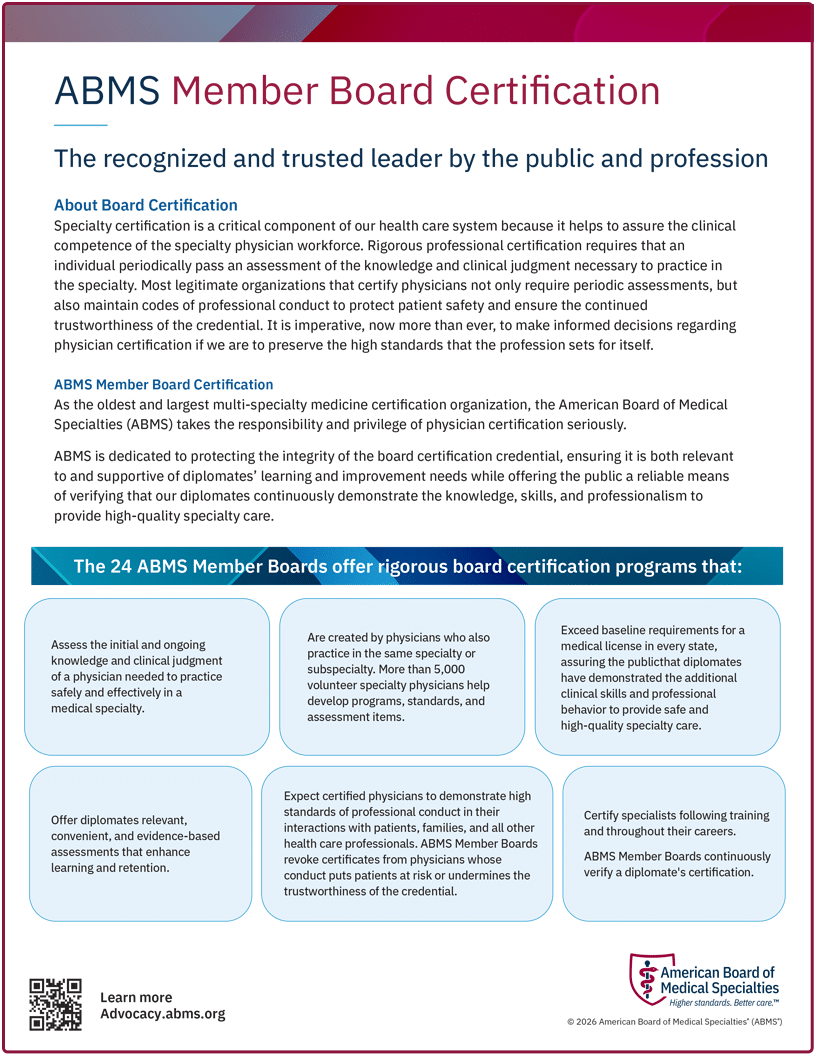
Understanding the Rigor of ABMS Board Certification Programs
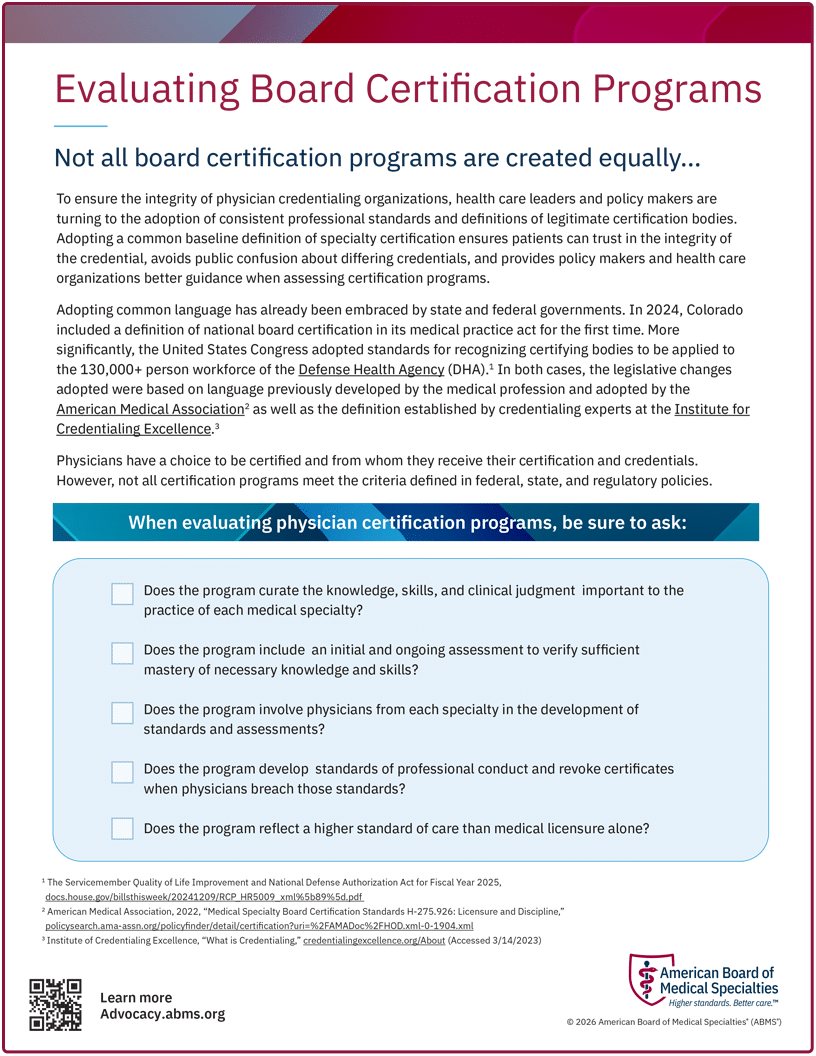
Evaluating the Legitimacy of a Board Certification Program
Advocacy Priorities
As the oldest and largest multi-specialty medicine certification organization, ABMS is dedicated to protecting the integrity of the board certification credential, ensuring it is both relevant to and supportive of physicians’ learning and improvement needs while offering the public a reliable means of verifying that they continuously demonstrate the knowledge, skills, and professionalism to provide high-quality specialty care. We advocate for:
- Protecting patient primacy and patient autonomy, and the ethical responsibility of clinicians to be honest, to fully inform patients, to treat all patients with dignity and respect, and to maintain relationships within professional norms.
- Protecting the patient-physician relationship, allowing patients to make health care decisions and receive evidence-based medical care for themselves and their families in partnership and in privacy with their physicians.
- The highest standards in physician certification programs, including definitions consistent with industry and professional standards.
- The rights of employers and health plans to use physician certification as a standard of quality in hiring, empaneling, and payment of physicians and specialists.
- Inclusion of physicians and specialists on care teams to provide patients with access to the comprehensive training and expertise in medical diagnosis, prescribing, and treatment that patients have come to expect for safe and effective health care.
- Maintaining high standards for physician training in specialty medicine and exploring alternative pathways to participation in physician certification for candidates who demonstrate competencies required for practice in the specialty through a rigorous process of initial and ongoing assessment.
- Promoting the ethical use of new technologies to enhance access to specialty care and improve assessment of physicians’ knowledge and skills.
- Define the knowledge and skills necessary to practice in their specialty.
- Practice according to the standards of care and professionalism for their specialty (AMA Code of Medical Ethics).
- Assess physicians on their specialty knowledge and clinical skills to determine whether they demonstrate the competencies and professionalism expected of certified specialists to provide safe, high-quality clinical care.
- Define standards for undergraduate, graduate and continuing medical education that will equip physicians with necessary specialty-specific knowledge, skills, and abilities to provide care equitably to all patient populations.
- Protect the authority of state medical boards and certifying bodies to enforce professional codes of conduct.
- Alignment of licensing, certification, and employment rules and regulations to reduce unnecessary administrative burden on physicians and specialists.
- Policies and regulations that allow for participation in ABMS continuing certification programs to meet CME requirements for license renewal.
- Practice environments that support the values of medical professionalism and the primacy of physician-patient partnerships to improve health and safety.
- Participation in health system, payer, hospital, and medical practice quality improvement and safety programs to satisfy continuing certification improving health and health care requirements.
- Decreased barriers to participation in physician health programs to encourage physician health, wellness and recovery through alignment of state licensure and ABMS Member Board professionalism policies.
ABMS Certification Matters Briefs
ABMS’ Certification Matters briefs provide further information on the critical role that ABMS board certified physicians play in promoting high-quality care and the value that they provide to the entire medical team. The briefs are designed to help frame and inspire conversations with relevant stakeholders and those who need to better understand a topic.
Enhanced Continuing Certification Approaches Offer Physicians Convenience and Relevance
How Continuing Certification Helps Physicians Stay up to Date
How ABMS Board Certification is Preferred and Trusted by Patients
Studies That Link Continuing Certification to Improvements in Patient Care
Why CME is Not Enough to Ensure Competency in a Specialty
Research That Ties Participation in Continuing Certification to Better Professional Behavior
Public Voices Help ABMS Live Its Mission
Licensing Pathways for Internationally Trained Physicians and National Standards for Specialty Medical Care
Recent Statements
Read ABMS statements addressing critical issues affecting physicians and specialists, the certification community, the health of the patients and communities we serve.
- ABMS Statement on its Continued Commitment to Maintaining High Medical Specialty and Professionalism Standards
- ABMS Position Statement on Promoting Professionalism
- Policy on Admission of New Medical Specialty Boards to Membership in ABMS
- ABMS Position Statement on Upholding Standards in Specialty Practice
- ABMS Renews Its Statement on Legislative Interference in Medical Education, Training, and Practice and Its Adverse Effects on Women’s Access to Reproductive Health Care
Learn More
How We Live Our Mission
Learn how our values and programs inspire innovation, physician engagement, and action toward better patient care.
Certification Data
Find information about specialties, certifications issued, and distribution of specialists by board, specialty, and state.
Standards for Certification
Discover how our standards help our 24 boards create programs that support the experience and value of certification.